

 2
2 0
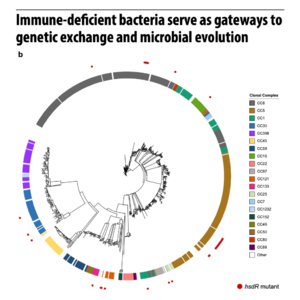
0This research explores how Staphylococcus aureus circumvents barriers to horizontal gene transfer to facilitate microbial evolution. While clonal complexes typically restrict the exchange of mobile genetic elements through Type I restriction-modification systems, the study identifies lateral transduction as a uniquely efficient mechanism for transferring chromosomal DNA across different lineages. Crucially, the authors discovered that certain immune-deficient bacteria act as gateways, accepting foreign genetic material and subsequently sharing it with other members of their group. These hsdR mutants are prevalent in nature due to an evolutionary trade-off where the risk of viral infection is balanced by the acquisition of advantageous traits like antibiotic resistance. Ultimately, these "promiscuous" recipient strains play a pivotal role in the emergence of novel virulence factors and the global spread of pathogenicity.
References:
- Figueroa W, Sabnis A, Ibarra-Chávez R, et al. Immune-deficient bacteria serve as gateways to genetic exchange and microbial evolution[J]. Nature Communications, 2026.
