

 0
0 0
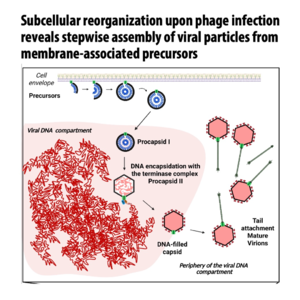
0This study utilizes advanced cellular electron cryo tomography to map the physical transformation of Bacillus subtilis bacteria during infection by the bacteriophage SPP1. Researchers discovered that the virus establishes a distinct DNA replication compartment that excludes host ribosomes, despite lacking a traditional membrane or shell. A critical finding is that viral assembly begins at the inner cell membrane, where the portal protein serves as a necessary anchor for early capsid precursors. These immature structures then migrate into the central viral zone to undergo stepwise DNA packaging, a process that triggers the expansion of the viral head. Once filled with genetic material, the capsids move to the compartment's periphery to attach pre-assembled tails and finalize maturation. Ultimately, this work provides a comprehensive spatial timeline of how a virus reorganizes a host cell to coordinate the production of new infectious particles.
References:
- Corroyer-Dulmont S, Labarde A, Pražák V, et al. Subcellular reorganization upon phage infection reveals stepwise assembly of viral particles from membrane-associated precursors[J]. Nature Communications, 2026.
