

 0
0 0
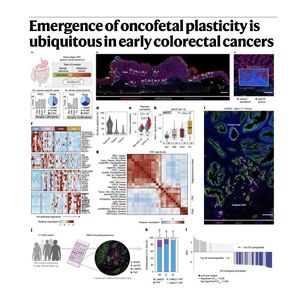
0This research identifies that metastasis-associated oncofetal cell states emerge at the earliest stages of colorectal cancer, specifically at the invasive front. By utilizing multiregional organoid models and whole-genome sequencing, scientists demonstrated that these aggressive traits are not caused by internal genetic mutations but are instead triggered by the tumour microenvironment. High-resolution spatial transcriptomics revealed that a specific fibroblast subtype, known as trophocyte-like cancer-associated fibroblasts, localizes at the invasive edge to induce these plastic, fetal-like states in cancer cells. While these cellular programs are essential for metastatic competence, they appear ubiquitously in early cancers, suggesting that actual spreading requires additional factors like immune evasion. Ultimately, the study concludes that the interaction between tumour cells and submucosal fibroblasts dictates the timing and location of malignant progression.
References:
Buissant des Amorie J R, Hageman J H, Brunner S R, et al. Emergence of oncofetal plasticity is ubiquitous in early colorectal cancers[J]. Nature, 2026: 1-11.
