

 0
0 0
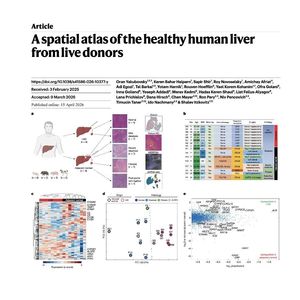
0This research presents a comprehensive spatial gene expression atlas of the healthy human liver, utilizing samples from live donors to overcome the limitations of deceased or diseased tissue. By employing spatial transcriptomics and single-nucleus RNA sequencing, the study identifies significant gene expression differences between truly healthy livers and the "adjacent normal" tissues typically used as medical references. The findings reveal that human liver zonation—the spatial distribution of cellular functions—differs markedly from mice, particularly regarding metabolic processes like gluconeogenesis and urea cycle regulation. The atlas further details how non-parenchymal cells communicate across liver zones and tracks the transcriptomic shifts occurring during early steatosis, such as mitochondrial changes. Ultimately, this work establishes a high-resolution reference frame for understanding both normal hepatic biology and the origins of metabolic liver diseases.
References:
Yakubovsky O, Bahar Halpern K, Shir S, et al. A spatial atlas of the healthy human liver from live donors[J]. Nature, 2026: 1-10.
