

 0
0 0
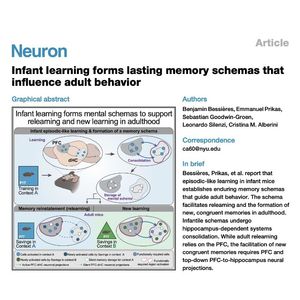
0Research indicates that infantile episodic learning creates enduring mental schemas that significantly impact behavioral development into adulthood. Although early memories often seem forgotten due to infantile amnesia, these latent representations undergo hippocampus-dependent systems consolidation to provide a foundation for future knowledge. In adult mice, these schemas specifically facilitate relearning and the acquisition of new, congruent information within the same learning domain. Neurologically, this process requires the reactivation of specific neural ensembles in the prefrontal cortex and the dorsal hippocampus that were first established during infancy. While adult relearning primarily engages cortical regions, the formation of new related memories relies on top-down projections from the prefrontal cortex to the hippocampus. Ultimately, the ability to form these influential, long-term frameworks from a single experience is a unique developmental prerogative of the infant brain.
References:
Bessières B, Prikas E, Goodwin-Groen S, et al. Infant learning forms lasting memory schemas that influence adult behavior[J]. Neuron, 2026.
