

 0
0 0
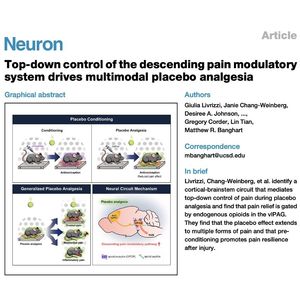
0This research identifies a cortical-brainstem circuit that enables the placebo effect to suppress pain in mice. By reverse-translating human conditioning paradigms, the study demonstrates that placebo analgesia requires the release of endogenous opioids within the ventrolateral periaqueductal gray (vlPAG). While both morphine and placebo responses utilize the same descending brainstem pathway, the placebo effect uniquely relies on top-down inputs from the prefrontal and cingulate cortex. These findings reveal that the placebo response is a powerful multimodal phenomenon that can generalize across different pain types. Ultimately, the authors suggest that preventative conditioning could be used as a clinical strategy to build lasting resilience against future injury-induced pain.
References:、
Livrizzi G, Chang-Weinberg J, Johnson D A, et al. Top-down control of the descending pain modulatory system drives multimodal placebo analgesia[J]. Neuron, 2026.
