

 1
1 0
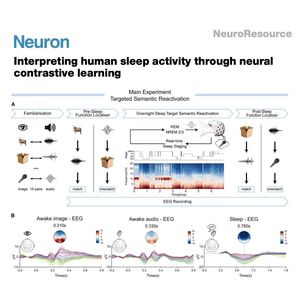
0The researchers developed the Sleep Interpreter (SI), a neural network designed to decode semantic memory reactivation from human brain activity during sleep. By utilizing neural contrastive learning, the model aligns waking and sleeping EEG signals to isolate specific memory content from the brain's background rhythmic patterns. The study leveraged a massive dataset of 135 participants and roughly 1,000 hours of sleep recordings to achieve high decoding accuracy, particularly during the coupling of slow oscillations and spindles. Validation experiments confirmed that the system generalizes to new participants and can even identify spontaneous memory replay without external cues. Furthermore, the team implemented a real-time decoding system that automates sleep staging and content readout, providing a tool for future clinical and cognitive interventions. This open-source resource represents a significant advancement in bridging the gap between wakeful experience and subconscious processing.
References:
Chen Z, Zheng H, Zhou J, et al. Interpreting human sleep activity through neural contrastive learning[J]. Neuron, 2026.
