

 1
1 0
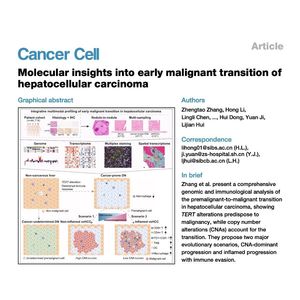
0This research examines the molecular and immunological drivers that facilitate the transition from premalignant dysplastic nodules to very early hepatocellular carcinoma (veHCC). By analyzing rare "nodule-in-nodule" samples, the authors discovered that while TERT alterations predispose tissue to malignancy, the actual shift to cancer is primarily driven by the accumulation of copy number alterations (CNAs) rather than single-nucleotide mutations. The study challenges the traditional view of liver cancer development by showing that these nodules exist in an immune-desert state characterized by low inflammation. As malignancy progresses, two distinct evolutionary paths emerge: a CNA-dominant progression and an inflamed progression where the tumor activates the immune system but simultaneously develops evasion strategies. These insights suggest that early immunotherapy intervention could potentially disrupt the transition to advanced liver cancer. Using spatial transcriptomics and organoid models, the researchers further validated specific gene losses, such as ECHS1 and FGA, as functional contributors to tumor growth.
References:
Zhang Z, Li H, Chen L, et al. Molecular insights into early malignant transition of hepatocellular carcinoma[J]. Cancer Cell, 2026.
