

 1
1 0
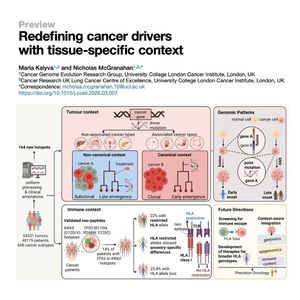
0This paper reviews a massive study of over 50,000 tumors that challenges the traditional gene-centric view of oncology by highlighting the role of tissue-specific context. The research identifies 164 new mutation hotspots that frequently act as early, disease-initiating events, particularly within tumor suppressor genes. By distinguishing between canonical and non-canonical drivers, the authors demonstrate that the same genetic mutation may appear at different stages of a tumor's life depending on the organ involved. The analysis also explores clinical correlations, such as how specific gene fusions link to early-onset disease, and evaluates the challenges of precision immunotherapy regarding immune escape. Ultimately, the source advocates for a context-aware framework in medicine where the biological environment is considered just as critical as the genetic mutation itself.
References:
Kalyva M, McGranahan N. Redefining cancer drivers with tissue-specific context[J]. Cancer Cell, 2026.
