

 1
1 0
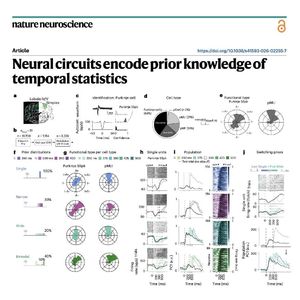
0This research explores how the brain uses Bayesian inference to navigate environmental uncertainty by internalizing the statistical structures of the world. Using a specialized eyeblink conditioning paradigm in mice, the study demonstrates that the cerebellum learns and encodes the prior probability distributions of temporal events. This internal knowledge is reflected in the firing patterns of Purkinje cells, which adjust their activity to match the timing and variability of the stimulus. Additionally, the discovery of a novel complex spike signal indicates a unique neural mechanism for marking the onset of high-uncertainty periods. Computational modeling suggests that these representations are acquired through the balancing of synaptic plasticity mechanisms within cerebellar circuits. Ultimately, these findings reveal that the cerebellum is a primary site for transforming accumulated experience into predictive motor behaviors.
References:
Koppen J, Klinkhamer I, Runge M, et al. Neural circuits encode prior knowledge of temporal statistics[J]. Nature Neuroscience, 2026: 1-10.
