
 17
17 0
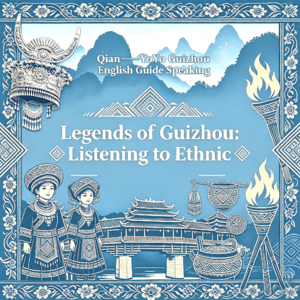
0Episode topic: Legends of Guizhou: Listening to Ethnic
Hosts: Lucia
Guests: Howard、Ivan
Duration: 40 minutes
Audience:
1. Candidates preparing for the foreign language tour guide exam
2. Foreign language tour guides
3. Tourism industry practitioners
4. Travel enthusiasts
Welcome to Qian-YoYo, your go-to program for Guizhou English tour guiding. I’m your host, Lucia. In the next forty minutes, let’s embark on a journey across the land of Guizhou. Our topic today is Legends of Guizhou: Listening to Ethnic Voices.
Known as a fairyland on the Yunnan-Guizhou Plateau, Guizhou boasts world-famous natural wonders and picturesque landscapes, including Huangguoshu Waterfall and Libo Zhangjiang Scenic Area.
01:33
Beyond the breathtaking landscapes, Guizhou is home to 17 ethnic groups that have lived here for generations, nurturing unique ethnic romance and timeless folk legends.
Exquisite Miao silver ornaments, heavenly melodies of the Dong Grand Chorus, and the graceful tunes of Buyi traditional music — all these are precious cultural treasures of Guizhou.
02:00
They embody distinct ethnic characteristics and carry the most genuine and heartfelt warmth of life hidden deep in the mountains. Now, please join me in welcoming our two special guests today — Howard and Ivan.
02:19
Thank you so much for having us. It’s a great pleasure to share our stories and thoughts about Guizhou with all of you today.
02:40
Hi everyone! I’m Ivan. I’m thrilled to be here today to share wonderful stories about Guizhou with you all.
02:53
A very warm welcome to both of you. As foreign language tour guides, our daily work is closely connected with Guizhou’s rich and diverse ethnic cultures.
We share local ethnic stories with global visitors in English, and pass on Guizhou’s unique cultural charm to the world.
03:15
I believe both of you have visited countless distinctive ethnic villages across Guizhou, and communicated a lot with local ethnic communities while guiding tours.
Among all the ethnic groups you’ve encountered, which one has left the deepest impression on you?
03:36
Is there any unique cultural symbol or icon that can best represent this ethnic group?
03:53
Most of my tour groups head to southeastern and southwestern Guizhou, where three autonomous prefectures are located in the southern part of the province.
I’ve been arranging my schedule for early May, from May 1st to 3rd — it’s the Labor Day holiday, and also the time when local communities in southeastern Guizhou celebrate an important traditional festival: the Sisters’ Festival.
It’s one of the most lively and representative festivals of the Dong people, full of ethnic customs and romantic traditions.
04:49
During the festival, young men and women take part in the traditional courtship activity — Singing While Wandering. Young girls gather together, and young men come singing folk songs to court them. It’s such a romantic folk custom.
05:22
Speaking of special ethnic groups in Guizhou, I’ve always been curious about the Chuanqing People. I looked up relevant information online, and found their historical origins have long been controversial.
05:38
Thank you for your wonderful sharing. Every ethnic group in Guizhou has its own unique charm. Personally, I’m really fond of the Dong people.
They are famous for three iconic cultural symbols: Dong Drum Towers, Wind-and-Rain Bridges, and the world-renowned Dong Grand Chorus.
06:00
Dong villages are built entirely of pure wood, without any metal nails or joints.
The drum tower is the spiritual and cultural center of every Dong village, serving as a venue for village meetings, celebrations and daily gatherings.
Wind-and-Rain Bridges, decorated with exquisite carvings, shelter pedestrians from wind, rain and sunshine all year round.
06:17
The Dong Grand Chorus is a precious intangible cultural heritage. It has no conductor and no musical accompaniment.
Singers imitate the sounds of birds, running streams and all kinds of natural scenery, creating music that sounds like nature itself. The Dong people are born lovers of singing and dancing.
06:39
They also have distinctive costumes, delicate silver ornaments, traditional weaving and exquisite handicrafts.
Their food culture is also unique, especially sour fish and sour meat, which are classic Dong delicacies. The Dong people are warm, hospitable and keep their ancient traditions well-preserved to this day.
07:01
Their simple lifestyle and profound folk culture make the Dong ethnicity truly unforgettable to every visitor.
07:15
Many tourists are curious about Guizhou’s ethnic cultures but know very little about them. Most have only seen online photos of Miao silver ornaments and Dong drum towers, with little idea of the interesting stories and cultural connotations behind these landmarks.
07:36
Today we’re going to talk about practical tips for foreign language tour guides when leading groups in Guizhou’s ethnic areas.
Howard, you mentioned you interact most with the Miao people in your daily guiding work, and it’s the ethnic group you’d love to share with us today.
07:58
Could you share your personal stories and special bond you have with the Miao people?
08:07
Sure. I spend a lot of time touring around ethnic areas, and I’d like to share an interesting experience.
A few years ago, I was invited by villagers in the mountainous area to attend a grand traditional festival — the Miao Drum Sacrifice Festival.
It’s held once every 13 years, and the celebration lasts for three years in total. I happened to join the third and final year of the festival celebration.
08:46
It was such a precious experience to be invited by local villagers. All Miao villagers dressed up in their finest costumes, circled around the drum to the rhythm of drumbeats, and joined in the grand celebration.
Young Miao girls were dressed in the most gorgeous ethnic costumes and silver ornaments.
09:15
Young men from neighboring villages were also invited, bringing with them the lusheng — a traditional bamboo wind instrument unique to the Miao and Dong people.
As young girls danced in a circle on the square, young men followed along, many clearly fascinated by the young ladies.
09:42
I watched a young man walking slowly beside the girl he admired, playing the lusheng nonstop for over an hour just for her. His sincere musical expression really touched the girl.
10:06
This is part of the traditional Miao courtship custom. Later, the girl presented a flower sash to the young man as a token of affection.
After the dancing and courtship, the parents of the young man and woman would meet to discuss their marriage, betrothal gifts and other wedding arrangements. It’s such a romantic and time-honored tradition.
10:58
Wow, what a well-preserved ancient tradition. These festival customs have been passed down in villages for centuries. It was such a precious experience for me to witness it in person.
11:17
Your sharing is truly touching. Those ordinary little details we often overlook are filled with warm cultural bonds, letting us gain new insights into the wisdom and life philosophy of the Miao people.
Alright, now let’s turn to Ivan for his sharing.
11:35
You spoke highly of the Chuanqing People earlier. Do you have any unforgettable guiding stories or unique insights into this special ethnic community?
11:58
I first learned about the Chuanqing People in geography class. What impressed me most is that they mainly reside in Guizhou alone.
They account for about 1.7 percent of Guizhou’s total population, and you can barely find settled Chuanqing communities in other provinces.
12:25
You can hardly find such a settled community anywhere outside Guizhou.
12:30
What a remarkable story. The culture of the Chuanqing People is filled with reverence for life and nature.
Many of their little-known customs are time-honored traditions rooted deeply in their cultural identity.
From daily communication with local residents to in-depth interpretation of cultural symbols, Ivan has given us a vivid introduction to this lesser-known group.
13:02
I believe all listeners, just like me, have gained a brand-new understanding of the Chuanqing People.
From a professional tour guide’s perspective, when you give on-site explanations in ethnic settlements, is there any ethnic group you always spend extra time introducing in detail?
13:39
Why do you love sharing its stories with travelers? Which ethnic group do you prioritize introducing to tourists? Is it the Chuanqing People we just talked about?
13:58
When I lead tour groups, I always introduce to visitors that there is a special community in Guizhou called the Chuanqing People.
They are not officially recognized as one of China’s 56 ethnic groups, yet their ID cards are marked with “Chuanqing” as their ethnic identity.
Their name derives from their traditional clothing style.
14:18
They wear indigo blue long robes, which look nearly black in dim light, long enough to cover the knees.
They coil their hair on top of the head fixed with silver threads, and traditionally wear straw sandals.
They worship a mountain spirit totem in the image of a monkey, which has been passed down as their ancestral totem for generations.
14:58
Historical records say their ancestors were once saved by monkeys, which is why the monkey totem is respected and even reflected on their costumes.
The Chuanqing People are mainly concentrated in Bijie and Liupanshui in Guizhou. There are two mainstream theories about their historical origins.
15:18
One theory holds that they are indigenous to Guizhou, known as ancient local tribes who have lived here since ancient times.
Historical documents record they once lived alongside local tribes and fought side by side against the Qing Dynasty army in ancient times.
Their costumes and living customs share many similarities with the Miao and other ethnic groups in Guizhou.
15:47
The other theory dates back to the early Ming Dynasty. Emperor Zhu Yuanzhang dispatched General Fu Youde with 30,000 troops to suppress rebellions in Yunnan and Guizhou.
After quelling the unrest, to consolidate rule, the imperial court arranged immigrants from Jiangxi, Anhui and other places — including officials, farmers, merchants and soldiers’ families — to settle in Guizhou.
This is the famous historical immigration event in Southwest China. These immigrants are the ancestors of the local Han settlement groups in Guizhou.
16:15
Many believe the Chuanqing People are descendants of these immigrant settlers who intermarried and integrated with local ethnic minorities.
There are still academic disputes over their origin, and complete historical records to verify their exact lineage are now missing.
16:48
That’s why many people in Guizhou often confuse the Chuanqing People with other immigrant descendant groups.
Notice that we always refer to them as a special community, not a formal ethnic minority.
17:16
Every officially recognized ethnic minority in China has a clear and complete historical and cultural origin.
But the Chuanqing People lack a unified origin record, their traditional customs are not fully preserved, and very few people can still speak their ancestral language.
17:46
That’s why they are categorized as an unrecognized special ethnic community in China. It’s not that they are excluded, but that they do not fully meet the national criteria for independent ethnic minority identification.
They are marked as “Chuanqing” on their ID cards as a special registered identity, though some electronic recognition systems cannot display the ethnic name properly.
China has many such unique unrecognized ethnic communities, all part of the big Chinese ethnic family with fascinating stories to tell.
18:07
The Chuanqing People hold deep reverence for mountain spirits and their monkey totem. It is forbidden to harm or scold monkeys out of respect for their ancestral belief.
During the Spring Festival, they have the custom of offering the first bowl of new rice to respected elders. They also have the tradition of not waking others up on New Year’s days, letting everyone rest and recharge for the new year.
20:10
That’s such a unique and heartwarming custom. Thank you for your detailed sharing.
Howard, you have rich experience in leading international tour groups. Have you encountered any impressive little stories over your years of practice?
20:47
Sure, I have countless interesting stories. Let me share one that is both interesting and practical for every tour guide.
I’ve guided foreign visitors to dozens of ethnic villages. I always believe a tour guide’s job is far more than just scenic introduction.
In ethnic areas, we are like a cultural bridge connecting tourists and local villagers.
21:05
We need to dig into local traditions, introduce them to foreign visitors, and act as a cultural interpreter between two sides.
I once guided a group of foreign visitors to a Miao village and had a precious encounter with the village shaman.
21:39
The visitors were very interested in Miao traditional beliefs and folk rituals. I was on good terms with the village shaman, so I politely asked if he could share his cultural traditions with our group.
He kindly agreed. We visited his home, sat together, and he told us about ancient Miao traditions, ritual taboos, and how he would choose his successor as the village shaman in his old age.
22:06
It was such a valuable and eye-opening experience. My point is: tour guides should communicate more with local villagers, respect their culture, and dig out more authentic folk stories for visitors.
22:27
After hearing your story, I’ve gained so much new knowledge. In-depth interpretation of ethnic culture not only enriches tourists’ travel experience, but also makes local people feel respected and recognized.
22:59
This is exactly where the true meaning of a tour guide’s job lies. When it comes to Dong cultural inheritance, there is a famous local folk love story: Zhu Lang and Yang Mei.
I wonder if you have ever told this story to foreign tourists during your guiding?
23:26
This story is just as touching as Romeo and Juliet in Western literature. It’s a classic tragic love story of the Dong people.
There is also the well-known cultural landmark Chejiang Sanbao Village, which now has convenient highway and high-speed rail access.
24:28
Let me walk everyone through this legendary Dong love story. It is adapted from a real event during the Qianlong reign of the Qing Dynasty.
Long ago in a Dong village, there lived a handsome young man named Zhu Lang and a beautiful, intelligent young lady named Yang Mei.
24:55
They fell deeply in love with each other through night singing and traditional Dong social activities.
But at that time, there was an old custom of cross-cousin marriage — girls were forced to marry their maternal cousins.
Yang Mei’s mother forced her to marry her cousin, and Zhu Lang’s family also arranged a cousin marriage for him.
26:03
They refused to accept the arranged marriage, so they decided to elope in pursuit of freedom and true love.
They traveled a long way and finally settled in a remote village, working for a wealthy local landlord named Yin Yi.
26:32
Yin Yi was captivated by Yang Mei’s beauty and tried to take her for himself. He framed Zhu Lang and had him killed secretly.
When Yang Mei learned the truth, she was heartbroken but determined to avenge her lover.
27:06
She made a clever plan: she beat the drum at the village drum tower and announced that whoever buried her husband’s body could marry her.
The greedy Yin Yi took the bait and followed her into the mountains. Yang Mei finally killed him to avenge Zhu Lang.
27:28
This folk story fully shows the Dong people’s admiration for true love, their courage to fight against unfair old customs, and their yearning for a free and happy life.
It also depicts the wisdom, bravery and kindness of Dong women, and the pursuit of freedom and equality among young Dong men and women.
27:54
When introducing ethnic cultures to foreign tourists, many guides easily make inappropriate remarks out of ignorance of local taboos.
Today we’ll sum up some common mistakes and share simple English polite reminders that guides can use directly on site.
28:20
Ethnic groups living in mountainous areas have preserved ancient traditions for centuries. As tour guides, we must fully respect their customs and taboos.
Some casual remarks that sound normal to outsiders may be extremely embarrassing, disrespectful or even offensive to local villagers.
28:34
I once took a group of international students to a remote Miao village. We stayed in the village for several days and arranged home-stay with local families.
29:16
We always arrange male and female students to stay with different families out of respect for local traditions.
But two young male students kept close contact with local girls and even kissed in public, which greatly offended the host family.
29:36
The host family was furious, regarded it as a serious insult to their custom, and complained to the village chief and our tour guide team.
30:06
We kept apologizing repeatedly, but the family still refused to forgive easily.
Finally, we turned to the village shaman for help. He hosted a traditional ritual to pray for blessings, offered sacrifices, and we presented gifts to the host family to make amends.
30:45
Only after the traditional ritual and sincere compensation did the family agree to forgive the students. It taught us a profound lesson on respecting ethnic taboos.
31:06
Thanks to our guests’ wonderful sharing today. In this episode, we’ve explored the unique cultures of the Miao, Dong and Chuanqing communities, together with practical tips for tour guide exam preparation, on-site guiding and travel planning.
Every ethnic group in Guizhou hides precious legends and cultural stories worthy of being passed down to the world.
31:33
As English tour guides, we are storytellers and cultural bridges, linking Guizhou to the whole world.
We hope today’s content brings valuable inspiration to foreign language guide candidates and all lovers of Guizhou ethnic culture.
32:06
We also invite you to visit Guizhou’s ethnic villages in person someday, and experience the charm of these living cultures firsthand.
Our program is coming to an end. Thank you again to our guests for your sincere and wonderful sharing.
32:28
Short as each episode is, the charm of Guizhou’s ethnic legends is boundless.
Stay tuned to Qian-YoYo, and listen to more stories of Guizhou told by professional English tour guides.
Feel free to leave your questions and comments below, and we’ll see you in the next episode!
34:11
Okay! See you next time.
