

 0
0 0
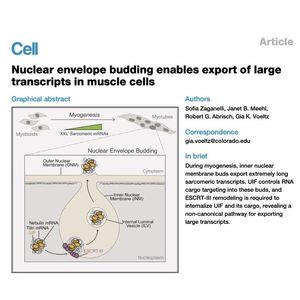
0This article describes the discovery of nuclear envelope budding (NEB) as a non-canonical export pathway for exceptionally large transcripts in mammalian muscle cells. While the nuclear pore complex typically restricts the passage of massive molecules, researchers found that differentiated myotubes utilize specialized buds derived from the inner nuclear membrane to transport extremely long sarcomeric mRNAs, such as titin and nebulin. The study identifies the RNA-binding protein UIF as a key regulator that targets these large cargoes into the buds, while the ESCRT-III membrane remodeling machinery facilitates the internalization of transcripts into luminal vesicles. By combining electron microscopy and proximity proteomics, the authors demonstrate that this mechanism is essential for proper muscle cell maturation and gene expression. These findings reveal that the cellular process previously thought to be exclusive to viral egress is actually a native pathway hijacked by pathogens to bypass traditional nuclear barriers.
References:
Zaganelli S, Meehl J B, Abrisch R G, et al. Nuclear envelope budding enables export of large transcripts in muscle cells[J]. Cell, 2026.
