

 0
0 0
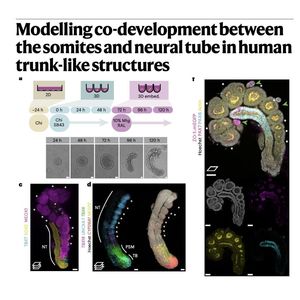
0Researchers have successfully engineered human trunk-like structures (hTLS) using pluripotent stem cells to investigate the complex co-development of the neural tube and somites. By precisely adjusting chemical signaling during the growth process, the team created 3D models that replicate the morphological organization and gene expression of a human embryo at approximately four to five weeks of development. These synthetic models allow scientists to observe how different tissues interact and influence each other's growth, such as how retinoic acid from somites helps pattern the nervous system. The study demonstrates that hTLS can serve as a scalable, ethical alternative to natural embryos for exploring axial elongation and the mechanical origins of human organogenesis. This modular approach provides a unique window into the reciprocal signaling pathways that ensure different body parts mature in a synchronized and functional manner.
References:
Makwana K, Tilley L, Chakravarty P, et al. Modelling co-development between the somites and neural tube in human trunk-like structures[J]. Nature Cell Biology, 2025: 1-14.
