

 0
0 0
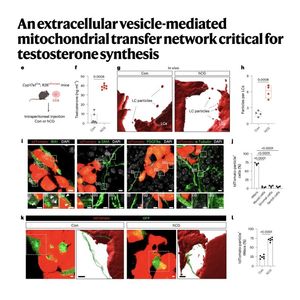
0This research identifies a sophisticated mitochondrial transfer network between Leydig cells (LCs) and testicular macrophages (tMacs) that is essential for testosterone synthesis. Leydig cells manage cellular stress by exporting defective mitochondria via extracellular vesicles to CD206hi macrophages, which eliminate the damaged organelles through a TREM2-dependent process. Simultaneously, LCs replenish their energy levels by acquiring functional mitochondria from MHCIIhi macrophages using VCAM1-mediated interactions. Disruption of this bidirectional exchange results in mitochondrial dysfunction, leading to significant declines in testosterone production, sperm quality, and overall male fertility. Furthermore, the study demonstrates that this protective network deteriorates with age, contributing to the systemic physiological decline associated with reduced hormone levels.
References:
Xia K, Zhang S, Peng H, et al. An extracellular vesicle-mediated mitochondrial transfer network critical for testosterone synthesis[J]. Nature Cell Biology, 2026: 1-18.
