

 0
0 0
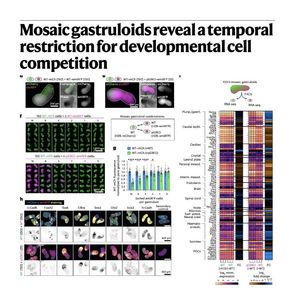
0This research utilizes mouse gastruloids as a three-dimensional model to investigate cell competition during early mammalian development. By introducing p53-deficient supercompetitor cells into wild-type populations, the authors demonstrate that even a tiny fraction of these aggressive cells can trigger mitochondrial apoptosis in their neighbors. The study identifies a specific temporal window—the transition from pluripotency to early gastrulation—where this competitive selection is most active. Unlike two-dimensional cultures that rely on resource limitation, this 3D embryonic model reveals that competition is driven by relative p53 protein levels and intrinsic stress signals. These findings establish that cell fitness evaluation is a tightly regulated quality control mechanism necessary for maintaining embryonic integrity. Ultimately, the work positions gastruloids as a powerful tool for studying how mammalian embryos eliminate suboptimal cells to ensure healthy development.
References:
Frenster J D, Babin S, Casani-Galdon P, et al. Mosaic gastruloids reveal a temporal restriction for developmental cell competition[J]. Nature Cell Biology, 2026: 1-15.
