

 0
0 0
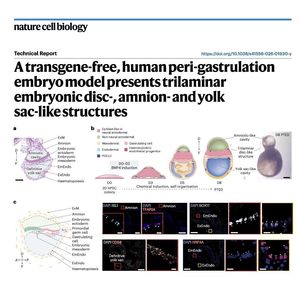
0This technical report introduces a transgene-free human embryo model known as the peri-gastrulation trilaminar embryonic disc (PTED) embryoid. Created from primed human pluripotent stem cells, these 3D structures successfully mimic the self-organizing properties of the critical human peri-gastrulation phase. The models feature a trilaminar disc situated between an amniotic-like sac and a yolk sac-like structure, effectively replicating early embryonic and extraembryonic development. Researchers utilized BMP4 induction and geometric confinement to trigger differentiation into major germ layers and primitive haematopoiesis. These findings suggest that the human epiblast retains the potential to contribute to extraembryonic lineages during this stage. Ultimately, PTED embryoids provide an ethically accessible tool for studying the fundamental mechanisms of early human life.
References:
Sun S, Zheng Y, Kim Y S, et al. A transgene-free, human peri-gastrulation embryo model presents trilaminar embryonic disc-, amnion-and yolk sac-like structures[J]. Nature Cell Biology, 2026: 1-17.
