

 0
0 0
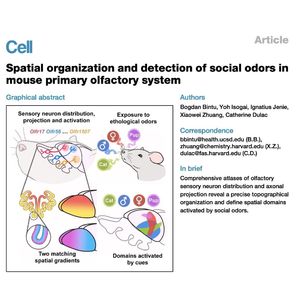
0This study utilizes MERFISH spatial transcriptomics to create a near-complete molecular atlas of the mouse primary olfactory system, mapping the expression of approximately 1,100 olfactory receptors. The researchers identified two distinct spatial gradients in the olfactory epithelium—central-to-peripheral and apical-to-basal—which directly correspond to organized projection axes in the olfactory bulb. By imaging activity markers alongside receptor expression, the authors defined specific spatial domains that respond to ethologically significant odors such as those from predators and social cues. The findings also reveal that maternal experience selectively enhances the sensitivity of specific sensory neurons to pup odors. Overall, this work establishes a high-resolution topographical map connecting genetic organization to functional sensory responses.
References:
Bintu B, Isogai Y, Jenie I, et al. Spatial organization and detection of social odors in mouse primary olfactory system[J]. Cell, 2026.
