

 1
1 0
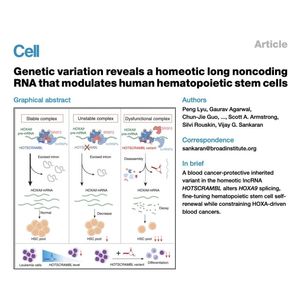
0Researchers have identified a novel long non-coding RNA named HOTSCRAMBL, which plays a vital role in regulating human hematopoietic stem cells (HSCs). A specific inherited genetic variant, rs17437411, disrupts this RNA’s structure and impairs its ability to recruit the splicing factor SRSF2 to the HOXA9 gene. This structural failure leads to inefficient HOXA9 splicing, which reduces the self-renewal capacity of stem cells and promotes their differentiation. While this process results in slightly lower blood counts, it serves as a protective mechanism against blood cancers and clonal hematopoiesis by limiting the expansion of potentially malignant cells. The study demonstrates that HOTSCRAMBL expression is a key driver in aggressive acute myeloid leukemias, where high levels correlate with poor patient outcomes. Ultimately, these findings highlight how human genetic variation can reveal sophisticated layers of gene regulation that fine-tune blood development and cancer resilience.
References:
Lyu P, Agarwal G, Guo C J, et al. Genetic variation reveals a homeotic long noncoding RNA that modulates human hematopoietic stem cells[J]. Cell, 2026.
