

 0
0 0
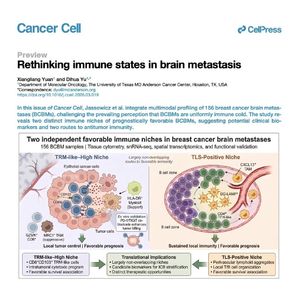
0This research challenges the traditional view of breast cancer brain metastases (BCBMs) as being uniformly resistant to the immune system. By analyzing over 150 clinical samples, scientists identified two unique immune niches—specifically TRM-like T cells and tertiary lymphoid structures—that correlate with significantly better patient survival. These distinct environments demonstrate that the brain can host organized, active antitumor responses that do not always mirror the primary tumor's biology. The study also highlights specific microglia-derived macrophage subsets that support these protective immune states rather than suppressing them. Ultimately, these findings suggest that immunotherapy for brain cancer should be guided by the specific cellular architecture of the intracranial lesion itself. This shift from seeing BCBMs as "cold" to "complex" offers a new framework for developing targeted treatments and more accurate diagnostic biomarkers.
References:
Yuan X, Yu D. Rethinking immune states in brain metastasis[J]. Cancer Cell, 2026.
