

 0
0 0
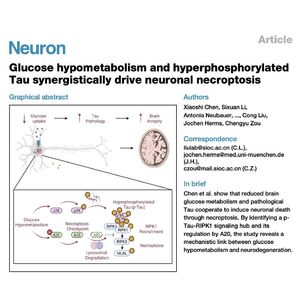
0This research explores how brain glucose hypometabolism and hyperphosphorylated Tau (p-Tau) collaborate to trigger neuronal necroptosis, a form of programmed cell death linked to cognitive decline. The study identifies that low glucose levels cause a significant reduction in the necroptosis checkpoint protein A20, while p-Tau acts as a scaffold to recruit and activate RIPK1 signaling. This synergy effectively removes cellular brakes on death pathways, leading to the brain atrophy and neuronal loss observed in tauopathies like Alzheimer’s disease. Experimental results demonstrate that restoring A20 levels via the dietary supplement acetyl-L-carnitine (ALCAR) or blocking the p-Tau-RIPK1 interaction can prevent neurodegeneration in mouse models. Furthermore, clinical analysis of AD patient hippocampi confirms a correlation between reduced glucose uptake, diminished A20 expression, and elevated RIPK1 activation. These findings highlight a novel metabolic-driven signaling hub that could serve as a promising therapeutic target for treating dementia.
References:
Chen X, Li S, Neubauer A, et al. Glucose hypometabolism and hyperphosphorylated Tau synergistically drive neuronal necroptosis[J]. Neuron, 2026.
