

 6
6 0
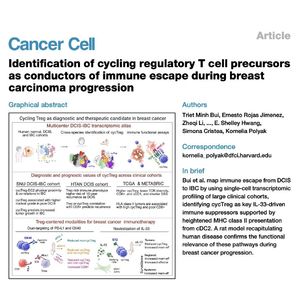
0This research identifies cycling regulatory T cells (cycTreg) as primary drivers of immunosuppression during the progression from preinvasive to invasive breast cancer. By analyzing large single-cell transcriptomic datasets from both humans and rats, the authors discovered that these specific cells expand significantly during the transition to invasive carcinoma, effectively blocking the body's natural immune response. The study demonstrates that type 2 dendritic cells (cDC2) and IL-33 signaling from fibroblasts are responsible for promoting the growth of these suppressive cells. Clinically, the presence of these cells predicts a higher risk of recurrence in early-stage patients and shorter survival in invasive cases. To combat this, the researchers successfully used OX40 agonists and IL-33 neutralization in animal models to reduce the cycTreg population and restore anti-tumor immunity. Ultimately, the sources highlight these cells as both a critical diagnostic biomarker and a promising new target for immunotherapy.
References:
Bui T M, Jimenez E R, Li Z, et al. Identification of cycling regulatory T cell precursors as conductors of immune escape during breast carcinoma progression[J]. Cancer Cell, 2026.
