

 0
0 0
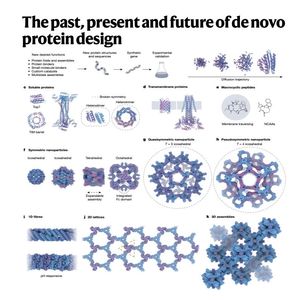
0This review article examines the evolution of de novo protein design, highlighting a significant transition from physics-based models to deep-learning-powered methodologies. The authors describe how advanced tools like RFdiffusion and ProteinMPNN allow scientists to build entirely new protein structures from scratch rather than modifying existing ones found in nature. By leveraging generative artificial intelligence, researchers can now create sophisticated molecules to address modern challenges in medicine, sustainability, and technology. The text outlines successful milestones, such as the creation of synthetic assemblies and protein binders, while identifying remaining hurdles like the design of complex catalysts. Ultimately, the source envisions a future where custom-designed nanomachines and materials perform functions far beyond the capabilities of natural evolution.
References:
Yang W, Wang S, Lee G R, et al. The past, present and future of de novo protein design[J]. Nature, 2026, 652(8112): 1139-1152.
