

 0
0 0
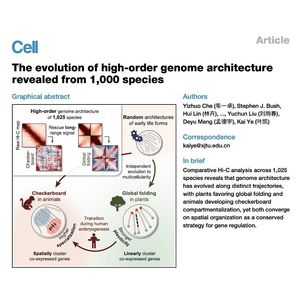
0The article examines the evolution of three-dimensional genome organization by analyzing Hi-C data from over 1,000 diverse species. Researchers identified two primary higher-order architectures: "global folding," which dictates the spatial arrangement of whole chromosomes, and "checkerboard," which represents the compartmentalization of chromatin. The study reveals that animals developed more complex checkerboard structures as they increased in biological complexity, whereas plants favored global folding and the linear clustering of genes. These findings suggest that while different kingdoms followed divergent evolutionary trajectories, they both utilized spatial organization as a fundamental strategy for gene regulation. Ultimately, the research supports the biological principle that genomic structure determines function across the entire tree of life.
References:
Che Y, Bush S J, Lin H, et al. The evolution of high-order genome architecture revealed from 1,000 species[J]. Cell, 2026.
