

 0
0 0
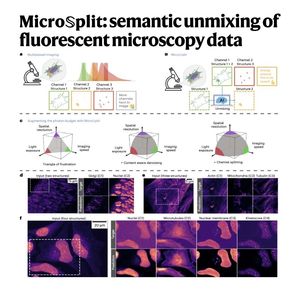
0The paper introduces MicroSplit, a deep learning-based method designed to enhance fluorescence microscopy by enabling computational multiplexing. By training Variational Splitting Encoder-Decoder networks, researchers can image multiple cellular structures simultaneously in a single fluorescent channel and then digitally unmix them into separate, denoised images. This innovation addresses the "triangle of frustration" in imaging, significantly reducing phototoxicity and light exposure while increasing imaging speed. A key feature of the system is its ability to estimate prediction uncertainty, allowing scientists to verify the reliability of unmixed data even without a traditional ground truth. Extensive testing across various datasets demonstrates that MicroSplit maintains high accuracy for downstream tasks like segmentation and can even be used to remove unwanted imaging artifacts. Ultimately, the authors provide these models and data as open-source resources to facilitate broader adoption in biological research.
References:
Ashesh A, Carrara F, Zubarev I, et al. Micro S plit: semantic unmixing of fluorescent microscopy data[J]. Nature Methods, 2026: 1-11.
