

 0
0 0
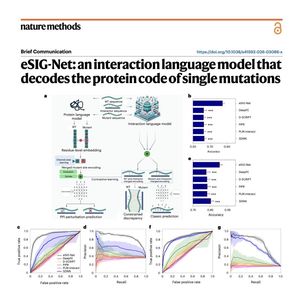
0The paper introduces eSIG-Net, a novel interaction language model designed to predict how single missense mutations disrupt protein-protein interactions (PPIs). Unlike traditional tools that rely on static structures or basic sequences, this framework utilizes mutation-centric encoding and constrained discrepancy learning to identify subtle "interaction cliffs" where tiny genetic changes cause massive functional shifts. Benchmark tests demonstrate that eSIG-Net significantly outperforms existing sequence-based and structure-based methods, achieving over 20% higher accuracy in identifying disease-linked variants. The sources highlight the model's ability to provide mechanistic insights into pleiotropic diseases, where different mutations in the same gene lead to distinct clinical outcomes. By generalizing across diverse biological contexts, the model serves as a scalable in silico tool for annotating variants of unknown significance and discovering new therapeutic biomarkers. Ultimately, this research offers a sophisticated computational solution for decoding the complex protein code that governs molecular networks in human health and disease.
References:
Pan X, Shrawat A, Raghavan S, et al. eSIG-Net: an interaction language model that decodes the protein code of single mutations[J]. Nature Methods, 2026: 1-6.
