

 1
1 0
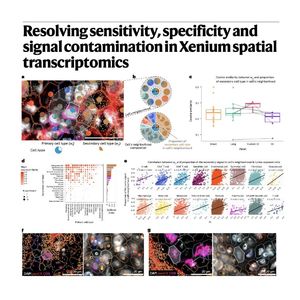
0This research introduces a large-scale dataset of breast and lung tumor sections to evaluate the performance and technical hurdles of Xenium spatial transcriptomics. The authors identify transcript spillover—the misassignment of genetic signals between neighboring cells—as a primary driver of data noise that blurs cell-type boundaries. To address this, they developed SPLIT (Spatial Purification of Layered Intracellular Transcripts), a computational framework that utilizes single-nucleus RNA sequencing to decompose and purify mixed signals. Their analysis reveals that while targeted gene panels offer higher sensitivity than larger 5K panels, both benefit significantly from signal refinement. Ultimately, the study provides a critical benchmark for spatial technologies and demonstrates that SPLIT enhances the resolution of complex biological signatures, such as T-cell exhaustion.
References:
Bilous M, Buszta D, Bac J, et al. Resolving sensitivity, specificity and signal contamination in Xenium spatial transcriptomics[J]. Nature Methods, 2026: 1-11.
