

 0
0 0
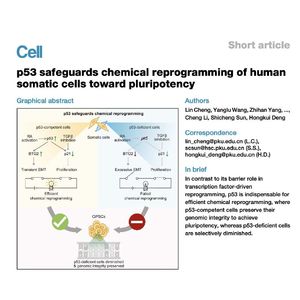
0This research identifies the tumor suppressor p53 as an indispensable driver of human chemical reprogramming, reversing its known role as a barrier in traditional transcription factor-based methods. While suppressing p53 helps create stem cells using the Yamanaka factors, doing so in chemical reprogramming leads to excessive EMT and prevents cells from reaching a pluripotent state. Small molecules, specifically the RAR agonist TTNPB and TGF-β inhibitors, work synergistically to activate p53 and its anti-metastatic target BTG2 while selectively suppressing cell-cycle inhibitors like p21. This unique molecular balance allows cells to proliferate rapidly while p53 remains active to monitor and eliminate cells with damaged DNA. Consequently, the resulting chemically induced pluripotent stem cells (CiPSCs) exhibit superior genomic integrity and fewer cancer-related mutations compared to traditional iPSCs. Ultimately, the study suggests that chemical methods mimic natural regeneration by leveraging intrinsic safeguards to ensure safe and efficient cell fate manipulation.
References:
Cheng L, Wang Y, Yang Z, et al. p53 safeguards chemical reprogramming of human somatic cells toward pluripotency[J]. Cell, 2026.
