

 0
0 0
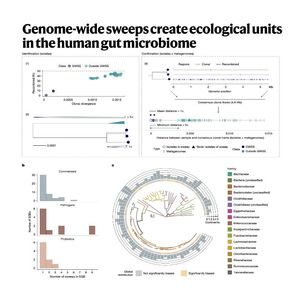
0This research explores how genome-wide selective sweeps (GWSSs) act as a fundamental evolutionary mechanism to organize the human gut microbiome into distinct ecological units. By analyzing thousands of bacterial genomes and metagenomes, the authors identified 124 confirmed sweep clusters across 66 different taxa, revealing that these populations can spread globally within decades. The study demonstrates that these genetically cohesive clusters are not just random variations but are ecologically differentiated populations with specific associations to host conditions like colorectal cancer, type 2 diabetes, and inflammatory bowel disease. Despite varying recombination rates, these sweeps allow adaptive clones to outcompete others and rediversify, creating a "broom-like" phylogenetic structure characterized by closely related strains on long branches. Ultimately, the findings provide a new theoretical framework for understanding microbial adaptation and suggest that these stable lineages could serve as precise biomarkers for human health.
References:
Yu X A, Strachan C R, Herbold C W, et al. Genome-wide sweeps create ecological units in the human gut microbiome[J]. Nature, 2026: 1-8.
