

 0
0 0
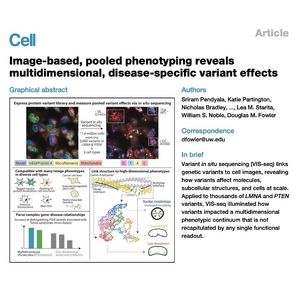
0This study introduces variant in situ sequencing (VIS-seq), a high-scale platform designed to map how genetic mutations alter the physical and functional characteristics of human cells. By combining pooled protein variant libraries with high-content fluorescent imaging, the method connects specific genotypes to complex cellular phenotypes, such as protein localization and organelle shape. Researchers applied this tool to thousands of mutations in the LMNA and PTEN genes, discovering how individual variants disrupt molecular structures to cause diverse diseases like autism and laminopathies. The findings reveal that genetic effects exist on a multidimensional continuum rather than a simple binary of healthy or diseased. Ultimately, this approach outperforms traditional predictive models by providing a spatial and mechanistic look at how mutations cascade from molecules to whole-cell architecture.References:
Pendyala S, Partington K, Bradley N, et al. Image-based, pooled phenotyping reveals multidimensional, disease-specific variant effects[J]. Cell, 2026.
