

 0
0 0
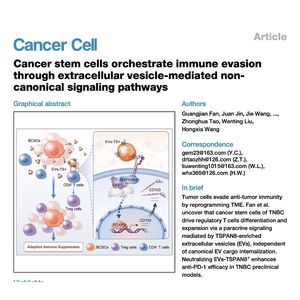
0This research identifies how cancer stem cells (CSCs) in triple-negative breast cancer orchestrate immune evasion through the secretion of extracellular vesicles (EVs). These vesicles carry the protein TSPAN8, which acts as a ligand that binds to CD103 receptors on T cells to trigger a specific metabolic signaling axis. This process drives the differentiation and expansion of immunosuppressive regulatory T cells (Tregs), creating a protected niche that facilitates tumor growth and metastasis. The study demonstrates that a positive feedback loop involving FOXP3 and CD103 sustains this environment, making it a primary driver of resistance to standard immunotherapies. Consequently, the authors show that neutralizing TSPAN8 can reprogram the tumor microenvironment and significantly improve the effectiveness of anti-PD-1 treatments. These findings establish TSPAN8 as both a prognostic biomarker and a viable therapeutic target for overcoming immune resistance in aggressive breast cancers.
References:
Fan G, Jin J, Wang J, et al. Cancer stem cells orchestrate immune evasion through extracellular vesicle-mediated non-canonical signaling pathways[J]. Cancer Cell, 2026.
