

 5
5 0
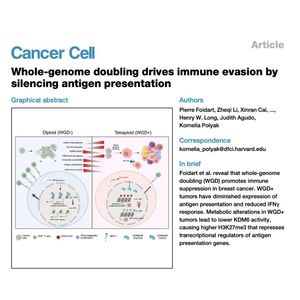
0This research reveals how whole-genome doubling (WGD) acts as a primary catalyst for immune evasion in breast cancer. By utilizing mouse models and clinical data, the authors demonstrate that WGD+ tumors transition from an early immunogenic state to a "cold" environment characterized by diminished antigen presentation. This suppression is driven by metabolic shifts, specifically increased succinate levels, which impair KDM6 activity and lead to elevated H3K27me3 histone marks. These epigenetic changes silence the transcriptional regulators necessary for MHC-I expression, effectively hiding the cancer cells from CD8+ T cell detection. Despite this resistance, the study identifies PRC2 inhibitors and the compound YM155 as potential therapeutic strategies to restore immune visibility and target WGD+ malignancies.
References:
Foidart P, Li Z, Cai X, et al. Whole-genome doubling drives immune evasion by silencing antigen presentation[J]. Cancer cell, 2026.
