

 0
0 0
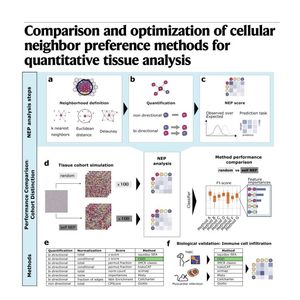
0This research article introduces and evaluates COZI, a novel computational method for quantitative tissue analysis in the field of spatial omics. By deconstructing existing neighbor preference (NEP) methods into three core stages—neighborhood definition, quantification, and scoring—the authors identify a gap in current analytical frameworks regarding bi-directional directionality and statistical sensitivity. The study utilizes simulated and biological datasets, including breast cancer and myocardial infarction samples, to demonstrate that COZI superiorly distinguishes subtle tissue architectures compared to traditional toolboxes. Ultimately, the paper provides a comprehensive guide for researchers to navigate the technical heterogeneity of spatial analysis, offering COZI as a robust solution for capturing how cells are functionally organized within their microenvironments.
References:
Schiller C, Ibarra-Arellano M A, Bestak K, et al. Comparison and optimization of cellular neighbor preference methods for quantitative tissue analysis[J]. Nature Communications, 2026, 17(1): 3514.
