

 1
1 0
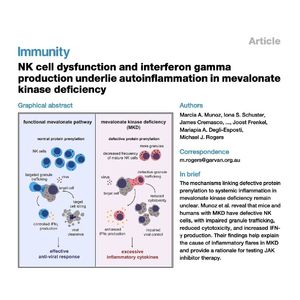
0This research examines how mevalonate kinase deficiency (MKD), a rare autoinflammatory disorder, causes severe immune system disruptions in both humans and mice. The study identifies a critical cell-intrinsic defect where a lack of protein prenylation leads to a significant reduction in mature natural killer (NK) cells. These defective cells exhibit impaired granule trafficking and reduced cytotoxicity, which prevents the body from effectively clearing viral infections. Paradoxically, this cellular dysfunction triggers an overproduction of interferon gamma (IFN-γ) and other inflammatory cytokines, resulting in systemic flares and tissue damage. By linking these metabolic failures to a dysregulated anti-viral response, the authors provide a scientific basis for using Janus kinase (JAK) inhibitors as a novel treatment. Testing in an infant with severe MKD suggests that this therapy can successfully ameliorate clinical symptoms by blocking excessive cytokine signaling.
References:
Munoz M A, Schuster I S, Cremasco J, et al. NK cell dysfunction and interferon gamma production underlie autoinflammation in mevalonate kinase deficiency[J]. Immunity, 2026.
