

 1
1 0
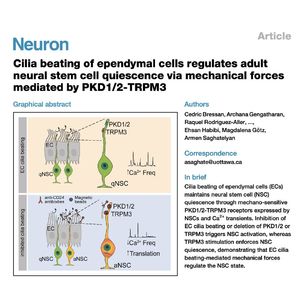
0This research identifies a novel mechanism where the mechanical forces generated by the beating cilia of ependymal cells are essential for keeping adult neural stem cells (NSCs) in a dormant, or quiescent, state. By utilizing an innovative method involving magnetic beads and electromagnetic fields to temporarily halt ciliary movement, the study demonstrates that even a brief interruption of these physical forces triggers NSC activation and increased protein translation. The researchers discovered that NSCs sense these vibrations through specific mechano-sensitive receptors, namely PKD1/2 and TRPM3, which regulate internal calcium signaling. Deleting these receptors effectively mimics the loss of cilia beating, leading to premature stem cell proliferation. Conversely, pharmacological stimulation of TRPM3 was shown to successfully restore the resting state of NSCs even when cilia were immobilized. Ultimately, the findings highlight how the physical environment of the brain's ventricular system directly governs the life cycle and activation of vital stem cell populations.
References:
Bressan C, Gengatharan A, Rodriguez-Aller R, et al. Cilia beating of ependymal cells regulates adult neural stem cell quiescence via mechanical forces mediated by PKD1/2-TRPM3[J]. Neuron, 2026.
