

 1
1 0
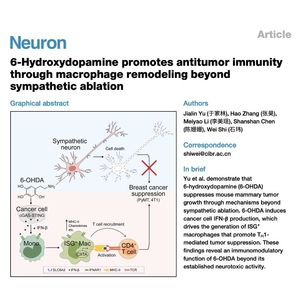
0The research explores how the chemical 6-hydroxydopamine (6-OHDA), traditionally used to destroy sympathetic nerves, actually suppresses breast cancer growth through immune system activation rather than nerve loss. By comparing various denervation methods, scientists discovered that only 6-OHDA inhibits tumors by triggering cancer cells to produce interferon-beta (IFN-β) via the cGAS pathway. This surge in interferon leads to the development of specialized pro-inflammatory macrophages that express interferon-stimulated genes. These unique macrophages subsequently recruit and activate T helper 1 (TH1) cells, which are the primary drivers of the observed antitumor immunity. The study ultimately reveals a significant, non-neurological function of 6-OHDA and identifies the macrophage-TH1 axis as a promising target for cancer therapy.
References:
Yu J, Zhang H, Li M, et al. 6-Hydroxydopamine promotes antitumor immunity through macrophage remodeling beyond sympathetic ablation[J]. Neuron, 2026.
