

 0
0 0
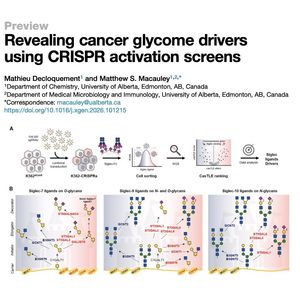
0Researchers utilized CRISPR activation screens to identify the genetic mechanisms that drive cancer-associated glycome remodeling, specifically the production of Siglec ligands that help tumors evade the immune system. By systematically upregulating thousands of genes, the study discovered that hypersialylation is not controlled by a single master regulator but emerges from a complex network of competing biosynthetic pathways. A significant finding was the role of the enzyme GAL3ST4, which promotes immune evasion in glioma by facilitating the creation of specific structural elements for Siglec-7 recognition. This research challenges previous models by demonstrating that Siglec-10 recognizes a diverse range of glycans rather than relying on a single carrier protein. Ultimately, these findings provide a functional framework for developing biomarkers and personalized immunotherapies aimed at disrupting the glycan-based shields used by cancer cells.
References:
Decloquement M, Macauley M S. Revealing cancer glycome drivers using CRISPR activation screens[J]. Cell Genomics, 2026, 6(4).
