

 1
1 0
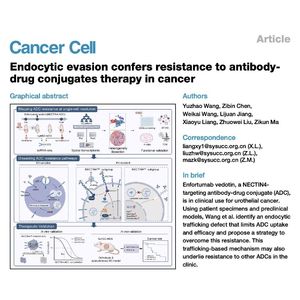
0This article from Cancer Cell investigates why some urothelial cancers develop resistance to the antibody-drug conjugate (ADC) Enfortumab vedotin (NECTIN4-ADC). Using single-cell RNA sequencing and spatial transcriptomics, researchers identified a specific tumor cell subpopulation that remains high in NECTIN4 expression but evades treatment through endocytic trafficking defects. The study reveals that the protein AKR1C1 blocks the internalization of the drug and works with WWP2 to export the ADC out of the cell via extracellular vesicles. This resistance state is driven by the transcription factor ELF3, which regulates both the drug target and the resistance-associated proteins. Crucially, the authors demonstrate that pharmacological inhibition of AKR1C1 restores drug uptake and significantly improves the effectiveness of ADC therapy in preclinical models. This discovery offers a promising strategy to overcome clinical resistance by targeting the mechanisms that control membrane trafficking and drug delivery.
References:
Wang Y, Chen Z, Wang W, et al. Endocytic evasion confers resistance to antibody-drug conjugates therapy in cancer[J]. Cancer Cell, 2026.
