

 0
0 0
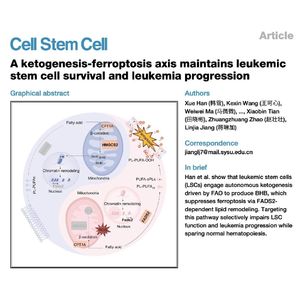
0This research identifies a self-contained ketogenic pathway that is essential for the survival of leukemic stem cells (LSCs) in acute myeloid leukemia. While ketone production is typically associated with the liver, these malignant cells utilize fatty acid oxidation to generate the ketone body BHB, which acts as a protective shield against cell death. This metabolic process works by epigenetically suppressing the enzyme FADS2, thereby preventing the remodeling of lipids into forms that are susceptible to ferroptosis, a type of iron-dependent oxidative rupture. Crucially, experimental deletion of the rate-limiting enzyme HMGCS2 successfully eliminated these cancer-initiating cells and halted disease progression in both mouse models and human samples. Because this pathway is specifically active in malignant cells, targeting it offers a promising therapeutic strategy to selectively destroy leukemia while leaving healthy blood-forming cells unharmed. Overall, the study reveals that autonomous ketogenesis is a hallmark of cancer stemness that maintains the structural integrity of the cell membrane under metabolic stress.
References:
Han X, Wang K, Ma W, et al. A ketogenesis-ferroptosis axis maintains leukemic stem cell survival and leukemia progression[J]. Cell Stem Cell, 2026.
