
 9
9 0
0Title:
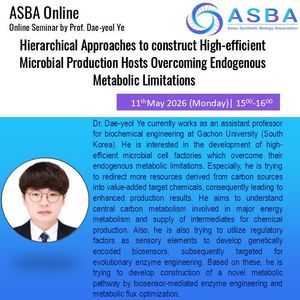
Hierarchical Approaches to construct High-efficient Microbial Production Hosts
Overcoming Endogenous Metabolic Limitations
Astract:
Metabolic engineering leverages native pathways and enzymes to enable microbial bioproduction; however, sub-optimal enzymatic activities and endogenous metabolic constraints often limit production efficiency and yield. Because microorganisms have evolved to prioritize survival rather than chemical synthesis, improving bioproduction typically requires multi-scale engineering strategies spanning both pathway- and enzyme-level interventions using two different engineering approaches: rational engineering and evolutionary engineering. In the enzymatic reaction scale, the researchers engineered several enzymes which showed improved catalytic activities or novel reactions to redirect more flux toward the target chemical production. In the metabolic pathway scale, more metabolic fluxes derived from substrates were rewired toward the target chemical by balancing them at the major metabolic node or redesigning the pathways to avoid carbon loss steps. Together, these results illustrate how coordinated pathway rewiring and enzyme engineering can effectively overcome native metabolic constraints, providing a generalizable framework for maximizing carbon efficiency and advancing sustainable bioproduction of value-added chemicals.
Personal Profile:
Dr. Dae-yeol Ye currently works as an assistant professor for biochemical engineering at Gachon University (South Korea). He is interested in the development of high-efficient microbial cell factories which overcome their endogenous metabolic limitations. Especially, he is trying to redirect more resources derived from carbon sources into value-added target chemicals, consequently leading to enhanced production results. He aims to understand central carbon metabolism involved in major energy metabolism and supply of intermediates for chemical production. Also, he is also trying to utilize regulatory factors as sensory elements to develop genetically encoded biosensors, subsequently targeted for evolutionary enzyme engineering. Based on these, he is trying to develop construction of a novel metabolic pathway by biosensor-mediated enzyme engineering and metabolic flux optimization.
