

 0
0 0
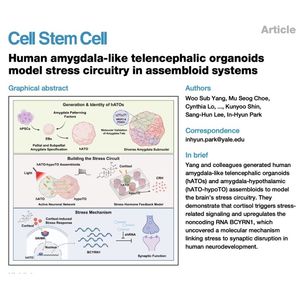
0Researchers have developed human amygdala-like telencephalic organoids (hATOs) and amygdala-hypothalamic (hATO-hypoTO) assembloids to study the development and stress response of the human limbic system. These models successfully replicate the cellular diversity and regional complexity of the amygdala, featuring integrated excitatory and inhibitory neural networks. By exposing these organoids to cortisol, the study demonstrates how stress hormones trigger specific signaling pathways and induce oxidative stress. A key discovery involves the upregulation of BCYRN1, a primate-specific noncoding RNA that appears to disrupt synaptic function and axonal growth. To observe circuit-level interactions, the team utilized a microfluidic chip system to show how hATOs communicate with hypothalamic tissues via CRH signaling. This experimental platform provides a new way to investigate how prenatal stress exposure might program long-term neurodevelopmental changes and neuropsychiatric vulnerabilities in humans.
References:
Yang W, Choe M, Lo C. Human amygdala-like telencephalic organoids model stress circuitry in assembloid systems. Cell Stem Cell, 2026; 0
