

 0
0 0
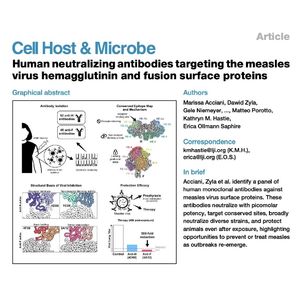
0This research identifies a new panel of human monoclonal antibodies isolated from an individual years after receiving the Measles-Mumps-Rubella (MMR) vaccine. These antibodies target the two primary surface glycoproteins of the measles virus, known as hemagglutinin (H) and fusion (F), which are essential for viral entry into host cells. Scientists mapped these antibodies into nine distinct epitope clusters and discovered several candidates with picomolar-level neutralization potency against diverse viral strains. High-resolution cryo-electron microscopy revealed that the most effective antibodies bind to highly conserved sites, effectively "locking" the viral machinery to prevent infection. In animal models, these human antibodies provided significant prophylactic and therapeutic protection, even when administered 48 hours after exposure. These findings suggest that these antibodies could serve as a powerful basis for new treatments to combat global measles outbreaks.
References:
Acciani M, Zyla D, Niemeyer G, et al. Human neutralizing antibodies targeting the measles virus hemagglutinin and fusion surface proteins[J]. Cell Host & Microbe, 2026.
