

 0
0 0
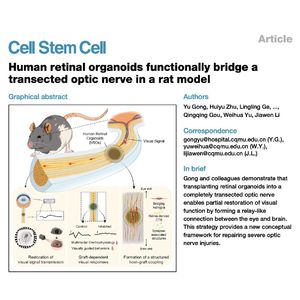
0Researchers recently developed a surgical technique called hROITON to address complete optic nerve transection in adult rats by transplanting human retinal organoids into the injury site. This study demonstrates that the transplanted organoids survive and integrate, establishing a relay-like bridge that supports neuroanatomical continuity between the eye and the brain. Treated animals exhibited a partial recovery of visual function, evidenced by restored pupillary light reflexes, electrical signal conduction, and visually guided behaviors. By utilizing chemogenetic inhibition, the scientists proved that these improvements were specifically dependent on the neuronal activity of the human graft. Through advanced 3D imaging, the team observed host axons and graft-derived processes forming synapse-associated structures aligned with bridge-like astroglial supports. This work provides a new conceptual framework for treating severe optic nerve damage by prioritizing functional reorganization over traditional anatomical restoration.
References:
Gong Y, Zhu H, Ge L, et al. Human retinal organoids functionally bridge a transected optic nerve in a rat model[J]. Cell Stem Cell, 2026.
