

 0
0 0
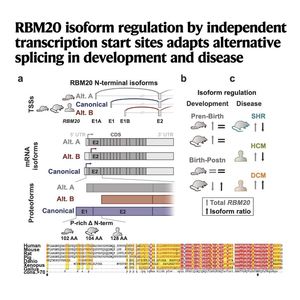
0This research identifies a novel transcription start site for the cardiac splicing regulator RBM20, which produces a shorter but functional protein isoform conserved across humans, mice, and rats. While the canonical isoform usually predominates, this alternative isoform lacks the first exon yet retains the ability to regulate alternative splicing for essential heart proteins like titin. The study demonstrates that the balance between these isoforms is strictly managed during cardiac development but becomes disrupted in different types of heart disease. Specifically, hypertrophic cardiomyopathy (HCM) is characterized by a significant upregulation of the alternative isoform, whereas dilated cardiomyopathy (DCM) shows a different regulatory pattern. These findings suggest that isoform-specific regulation serves as a vital control mechanism in the heart, offering new possibilities for targeted therapeutic strategies to treat cardiac dysfunction.
References:
Radke M H, Badillo Lisakowski V, Meinke S, et al. RBM20 isoform regulation by independent transcription start sites adapts alternative splicing in development and disease[J]. Nature Communications, 2026, 17(1): 4607.
