

 0
0 0
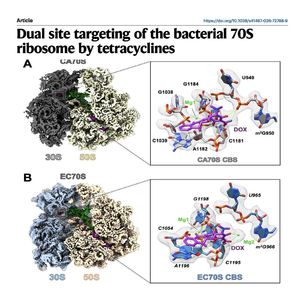
0Researchers have identified a dual-site mechanism of action for the tetracycline class of antibiotics, revealing that these drugs target both the mRNA decoding center and the nascent peptide exit tunnel (NPET) of the bacterial ribosome. Using high-resolution cryo-electron microscopy, the study demonstrates that while tetracyclines traditionally disrupt translation at the 30S subunit, they also bind near the peptidyl-transferase center in the 50S subunit. Doxycycline was uniquely found to dimerize within the NPET, creating a multi-layered stack that physically obstructs the path of the growing protein chain. Comparative analysis between E. coli and C. acnes shows that species-specific ribosomal variations significantly influence how these drugs interact with their targets. These structural insights clarify why certain tetracyclines remain effective against antibiotic-resistant strains and provide a blueprint for designing more precise, narrow-spectrum antibiotics.
References:
Devarkar S C, Lomakin I B, Wang J, et al. Dual site targeting of the bacterial 70S ribosome by tetracyclines[J]. Nature Communications, 2026, 17(1): 4452.
