

 0
0 0
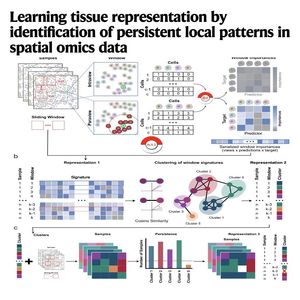
0This paper introduce Kasumi, a novel computational framework designed to analyze spatial omics data by identifying persistent local patterns within tissues. Unlike traditional methods that rely solely on cell-type clustering, Kasumi uses unsupervised multi-view modeling to capture complex, non-linear relationships between cells and their molecular markers. This approach allows researchers to represent tissues as a collection of meaningful neighborhoods that remain consistent across different samples and clinical conditions. The research demonstrates that Kasumi significantly improves patient stratification for cancer progression and treatment response compared to existing techniques. Furthermore, the tool provides explainable insights into how specific cellular interactions correlate with unfavorable medical outcomes. By offering an open-source R package, the authors provide a scalable solution for extracting biological knowledge from high-dimensional spatial proteomics and transcriptomics.
References:
Tanevski J, Vulliard L, Ibarra-Arellano MA, Schapiro D, Hartmann FJ, Saez-Rodriguez J. Learning tissue representation by identification of persistent local patterns in spatial omics data. Nat Commun. 2025 Apr 30;16(1):4071. doi: 10.1038/s41467-025-59448-0. PMID: 40307222; PMCID: PMC12044154.
