

 0
0 0
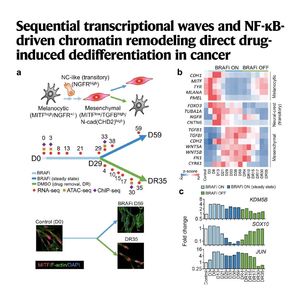
0This study investigates how melanoma cells escape treatment by transitioning into drug-tolerant persister states through a process of reversible dedifferentiation. By analyzing multi-omics data, the researchers identified that this transition is driven by two sequential transcriptional waves that orchestrate a global reconfiguration of the chromatin landscape. The first wave is triggered by oxidative stress following oncogene inhibition, which leads to NF-κB/RelA activation and the recruitment of histone-modifying enzymes. These early epigenetic changes then silence critical lineage-defining genes, such as SOX10, pushing the cancer cells toward a more resistant, mesenchymal state. This mechanism was validated across multiple cancer types, suggesting that targeting the NF-κB axis or epigenetic machinery could prevent the onset of therapy resistance. Ultimately, the research reveals that a cancer cell's plasticity—its ability to adapt and survive—is quantitatively encoded in its baseline chromatin accessibility.
References:
Su Y, Liu C, Lu X, Chuang HY, Li G, Shao S, Kong Y, Lee JW, Ng RH, Wong S, Robert L, Warden C, Liu V, Chen J, Wang Z, Qin G, Tang Y, Cheng H, Ng AHC, Chen D, Peng S, Xue M, Johnson D, Xu Y, Wang J, Wu X, Shmulevich I, Shi Q, Levine R, Ribas A, Baltimore D, Guo J, Heath JR, Wei W. Sequential transcriptional waves and NF-κB-driven chromatin remodeling direct drug-induced dedifferentiation in cancer. Nat Commun. 2026 Apr 15;17(1):3228. doi: 10.1038/s41467-026-71349-4. PMID: 41986344; PMCID: PMC13083995.
