

 1
1 0
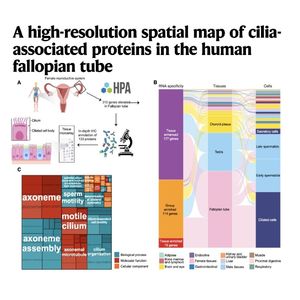
0This research presents a high-resolution spatial map of proteins within the human fallopian tube, specifically focusing on those associated with motile cilia. By integrating transcriptomics, proteomics, and immunohistochemistry, the study identifies 310 genes with elevated expression in this tissue, validating 133 proteins at a subcellular level. The findings reveal a shared core of ciliary proteins across different human organs and characterize several previously undefined proteins essential for reproductive health. Furthermore, the authors demonstrate how hydrosalpinx, a common cause of infertility, disrupts these protein expression patterns and epithelial structures. This comprehensive atlas provides a vital resource for understanding the molecular pathways of ciliary function and the pathophysiology of reproductive disorders.
References:
Hikmet F, Digre A, Hansen J N, et al. A high-resolution spatial map of cilia-associated proteins in the human fallopian tube[J]. Nature Communications, 2026, 17(1): 3616.
