

 6
6 0
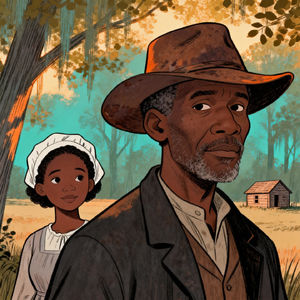
0每天五分钟听经典英文故事,读绘本,磨耳朵。被卖往南方的黑奴汤姆,在苦难中始终坚守善良与尊严,他的故事曾唤醒一个时代对奴隶制度的反思。
The night in Kentucky was quiet, but the lights were still on at the Shelby house.
Inside, the debt collector sat at the table, talking prices while his eyes looked over people like livestock. He had his eye on Tom, and on little Harry too. One was a man who had managed his master's affairs for years, never running, never stealing, never talking back; the other was a child still clinging to his mother Eliza's arms.
Mrs. Shelby could not believe it was happening. Tom had been with this family for so many years — his wife Chloe worked in the kitchen, his children grew up beside the little cabin. But when debt comes pressing down and a man is written into a contract, even crying cannot stop it.
Eliza heard her son's name from outside the door, and her blood went cold. She had no time to beg anyone, no time to wait for daylight. In the dark, she took Harry in her arms, grabbed what she could carry, and left the home she knew — the home she could never trust again.
The river was crusted with broken ice, and someone was chasing behind her. The child in her arms was shivering, and so was she, but she could not stop. Ice cracked beneath her feet as she jumped from one floe to the next, her shoes soaked, her hands bleeding, but as long as the child was in her arms, she dared not look back.
Tom knew he had been sold too.
He could have run. Some told him to run. But he thought of Chloe, thought of the children, thought of the Shelbys' debt, thought of how someone else might be taken in his place if he fled. He sat in the little cabin like a piece of wood sinking into water, pressing his fear deep into his chest, and only said he would go.
The next day, Tom was taken away. Chloe packed his things, her hands so busy they could not stop, because the moment they stopped, she would fall apart. She stuffed in everything she could think of, as if an extra shirt or a little more food could shorten the long road south.
The boat moved downstream, the river growing wider, taking Tom farther and farther from home.
On the boat, he met little Eva. The white girl had a thin body but bright, clear eyes, and she did not look at skin color and price the way grown-ups did. She talked to Tom, listened to him sing, and treated him like a living person who could feel cold, feel tired, feel homesick.
One day, Eva fell from the boat into the water. Tom hardly thought — he jumped in and pulled her out. Eva's father, St. Clare, bought Tom for saving her and brought him to New Orleans.
The St. Clare house was grand — fine furniture in the rooms, a garden trimmed just so, servants coming and going — yet something felt hollow in it. St. Clare was tired of slavery but still enjoyed the comfort it gave him; his wife Marie cared only for her own aches and her own temper; and his cousin Ophelia stood by her principles while carrying the prejudices of the North.
For a while, no whip chased Tom here. He drove the carriage for St. Clare, kept Eva company, and watched the little girl grow weaker day by day. Eva was like the softest light in that house — but the brighter the light, the sharper the shadows became.
When Topsy was brought before Ophelia, nobody knew what to do with her. She had been beaten, scolded, and treated like trouble ever since she was small, and so she had learned to lie, to steal, to hide herself behind a grinning face. Ophelia tried to change her with rules, but Eva simply looked at her with care, as if Topsy was not something broken.
Eva grew sicker and sicker.
She cut off her curly hair and gave it to the people around her. She spoke to Tom, spoke to her father, and spoke to those who were usually ordered about and overlooked. She did not know how to change this house, but before she died, she still wanted them to remember — that they had been loved, and that they deserved to be loved as human beings.
After Eva was gone, it was as if St. Clare had woken up halfway. He promised Tom he would give him his freedom. In that moment, Tom finally saw a road home — he might see Chloe again, might return to the little cabin in Kentucky, might walk through his own door on his own two feet.
But before the papers could be signed, St. Clare was caught in a fight and died from his wounds.
That sheet of freedom, never finished, could not save Tom. Marie had no heart to trouble herself over him, and soon the slaves of the house were sent to auction. Tom stood among the crowd, turned back into a price, measured by strangers' eyes, handled by strangers' hands.
The man who bought him was named Simon Legree.
Legree's plantation lay deeper in the South, where there was no Eva, no brief kindness like the St. Clares', only cotton fields, the smell of whiskey, the overseer, and the crack of the whip. People were worked down to their last breath, then sent to the fields again the next day. Sick, you worked; broken, you worked; crying was worth nothing here.
Legree saw that Tom was different. He wanted to turn this quiet, hardworking, trusted man into his own tool. If only Tom would manage the others for him, would swing the whip, would learn to be cruel — then his days could be easier.
Tom would not.
He could bear being beaten, but he would not pass the pain on to anyone else. The more Legree tried to break him, the more he hated that thing in Tom's eyes that would not go out. It was not a shout of defiance — just a man, in the worst of places, still holding on to the line that said he would not hurt another.
On the plantation were also Cassy and young Emmeline. Cassy had had her children taken from her, had been hardened by torment, and she had long seen through Legree's fear and weakness. She took Emmeline and escaped, hiding in the attic that was whispered to be haunted, using Legree's own superstition to frighten him away.
When Legree could not find them, he came for Tom.
Tom knew what kind of darkness awaited them if they were caught. He was dragged out, threatened, beaten — and still he said nothing. Blood ran down from his body, but his voice did not give away the path to another's life.
By the time George Shelby finally found the plantation and came with money to buy Tom back, it was too late.
Tom lay there, his body ruined, but his eyes recognized the child of his old home. He did not return to Kentucky, did not see Chloe again, did not walk into that little cabin. He only heard someone calling him home, like hearing the sound of a river from far away.
George knelt beside him and finally understood — some debts can never be repaid with money.
Later, George went back to Kentucky and set free every enslaved person in his household. Eliza, George, and Harry crossed the border at last and found their footing in Canada, and the scattered family slowly found their way back to one another.
And Tom's cabin still lives in memory. A fire once burned in the hearth there, a wife once cooked by the stove, children once ran in and out the door. A man was sold from that place, carried through rivers and steamboats and mansions and cotton fields, and in the end he did not bring back freedom — but he left the living unable to pretend any longer that those who were priced had no names, no homes, no souls.
