

 3
3 0
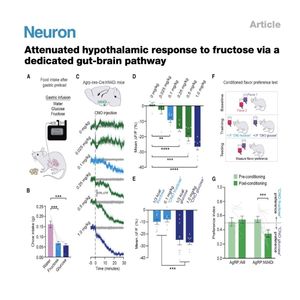
0This study demonstrates that AgRP neurons in the hypothalamus do not act as simple calorie detectors but can actually distinguish between fructose and glucose. Research shows that fructose is significantly less effective at inhibiting these hunger-regulating neurons than glucose, a difference that directly influences food preference rather than immediate satiation. Mechanistically, fructose suppresses these neurons by triggering the release of the hormone PYY, which then communicates through Y2 receptor-expressing vagal nerves. While glucose relies on a spinal-brain pathway, fructose utilizes a dedicated gut-vagal-brain circuit. These findings highlight that specific nutrient identities uniquely engage the gut-brain axis to regulate feeding behavior. Furthermore, the data suggests that adding glucose to fructose—as seen in high-fructose corn syrup—increases both neural inhibition and animal preference.
References:
McKnight A D, de Araujo A, Hsu F Y, et al. Attenuated hypothalamic response to fructose via a dedicated gut-brain pathway[J]. Neuron, 2026.
