

 1
1 0
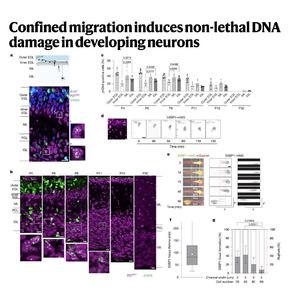
0A study reveals that developing neurons experience significant DNA double-stranded breaks as they migrate through narrow spaces in the brain. Unlike cancer cells, which often suffer DNA damage due to nuclear envelope rupture, these neurons maintain their membrane integrity while experiencing mechanical stress. Researchers discovered that this damage is primarily linked to topoisomerase-IIβ activity and is typically resolved through non-homologous end-joining repair mechanisms. If these lesions are not properly fixed, the resulting genomic instability can lead to persistent DNA accumulation and motor deficits later in life. This finding suggests that the physical act of confined migration during brain formation presents an inherent risk to long-term neuronal health. Consequently, robust DNA repair processes are essential for protecting the brain from early neurodegeneration and functional decline.
References:
Zhang Z, Canela A, Kurisu J, et al. Confined migration induces non-lethal DNA damage in developing neurons[J]. Nature, 2026: 1-10.
